
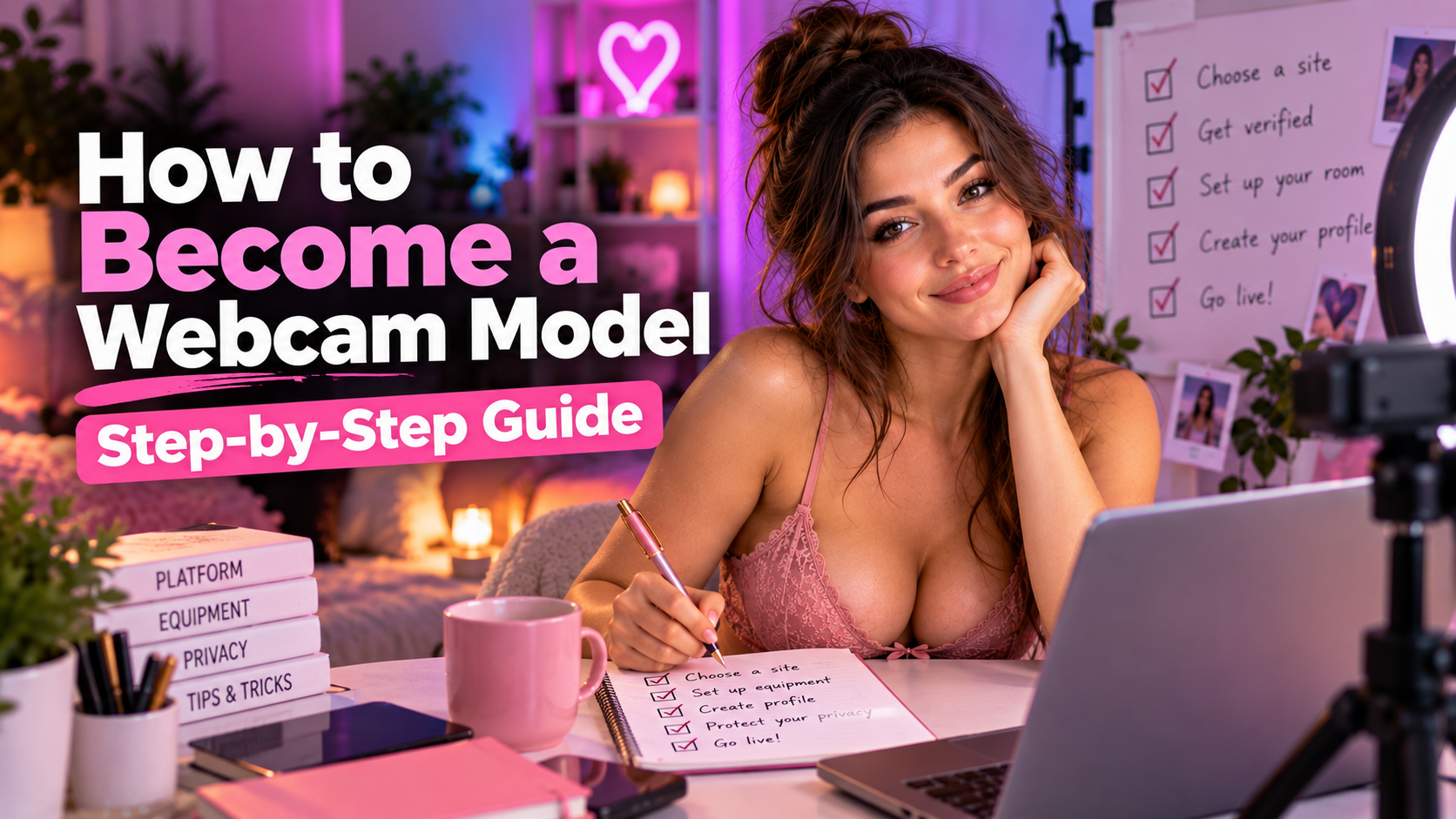
So you’re thinking about becoming a webcam model.
Maybe you’ve seen models working from home and wondered whether you could do the same thing. Maybe you’re looking for a flexible way to make money online. Or maybe you simply like the idea of performing, meeting people and building an audience of your own.
Whatever brought you here, becoming a webcam model is relatively easy. Becoming a successful webcam model takes a little more preparation.
You’ll need to choose where you want to work, verify your identity, figure out how you’ll get paid, create a separate model persona, set up your streaming space and decide what you’re comfortable doing on camera.
And no, you don’t need to have everything perfectly figured out before your first stream.
This guide will walk you through the process step by step.
What Is a Webcam Model?
A webcam model is someone who broadcasts themselves live over the internet and earns money from viewers through features such as tips, private shows, subscriptions and other paid interactions.
Adult camming is what we’re primarily talking about on OCamGirl, although exactly what happens during a stream depends on the model, the platform and the type of audience they’re building.
One thing worth understanding from the beginning is that there isn’t one particular “look” required to become a cam model. The original version of this guide made the same point: models come in different shapes, sizes and appearances, and different audiences are attracted to different people.
Personality matters too.
Being able to talk to people, entertain a room and make viewers want to return can be just as important as how you look on camera.
Step 1: Decide Whether Camming Is Right for You
Before buying equipment or creating accounts, think about whether you actually want to do this.
Camming can offer flexibility and the ability to work independently, but you’re also putting yourself in front of strangers on the internet.
That’s something you should be genuinely comfortable with.
Think about your boundaries before money enters the equation. What are you comfortable showing? What aren’t you comfortable doing? Are you comfortable being recognized? How would you feel if someone you knew eventually discovered your model identity?
You don’t need to know exactly what every future show will look like.
You should know your non-negotiable boundaries.
And those boundaries are yours. You don’t have to do something simply because another model does it or because a viewer offers you money.
Step 2: Make Sure You’re Eligible
Adult webcam platforms require models to meet their age and identity-verification requirements before broadcasting.
Expect to provide identification and complete whatever verification process your chosen platform requires.
Don’t try to bypass it.
Also remember that camming can involve tax, employment, business and adult-content regulations that differ depending on where you live and how you work.
A cam site approving your account doesn’t automatically answer every legal or tax question relevant to your situation.
If you’re unsure about local requirements, get appropriate professional advice before treating camming as a source of income.
Step 3: Decide Between Independent Camming and a Studio
You can work independently or, depending on where you live and the platforms available to you, through a webcam studio.
Working independently gives you more control. You choose your setup, schedule, platforms and working environment, and you manage the business side yourself.
A studio may provide a room, equipment, technical support, training or account assistance. In return, the studio may have its own compensation arrangement with you.
Neither option is automatically better.
If you’re considering a studio, understand the agreement before joining. Find out how much you’re paid, how payments work, who controls your model account and what happens to that account if you leave.
Don’t make the decision based entirely on somebody promising you huge earnings.
Know what you’re agreeing to.
Step 4: Create Your Model Identity
Do this before you start promoting yourself.
Choose a model name that isn’t connected to usernames you’ve used in your personal life. Create a separate email address and separate model social accounts if you plan to use social media.
Keep photographs created for your model persona separate from photographs you’ve posted on personal accounts.
You don’t need to invent an enormous fake biography with a fictional hometown, childhood dog and imaginary college roommate.
You need separation.
Think of your model identity as a public-facing brand and your real identity as private information.
Your real name, home address, personal phone number, workplace, school and private social accounts don’t need to become part of the show.
If privacy is important to you, read 10 Privacy Mistakes Camgirls Make That Jeopardize Their Privacy before your first stream, not after something goes wrong.
Step 5: Choose a Cam Site
Now you need somewhere to work.
This decision matters because cam platforms aren’t interchangeable. They can have different audiences, monetization systems, payment methods, traffic levels and rules.
Some platforms are heavily focused on public rooms and tips. Others put greater emphasis on private sessions or premium experiences.
A huge site isn’t automatically the best site either. More traffic can mean more potential viewers, but it can also mean more models competing for their attention. The original guide made essentially the same observation when discussing site size and competition.
Before registering, investigate:
- How models earn
- How tokens or credits convert into money
- Available payment methods
- Minimum payout
- Payment schedule
- Geographic availability
- Privacy controls
- Platform rules
Don’t obsess over finding the mythical cam site that “pays the most.”
The best platform is the one where you can actually attract paying viewers and get paid reliably.
We’ve compared several established platforms in 7 Best Cam Sites for Models if you need somewhere to start your research.
Step 6: Complete Verification
Once you’ve chosen a platform, you’ll normally need to complete its model verification process before you can earn money.
Follow the platform’s current instructions carefully.
Make sure the information you submit is accurate and that you’re registering through the official model-registration process.
This is also a good time to secure the account properly.
Use a strong, unique password that you aren’t using anywhere else. Enable two-factor authentication if the platform provides it.
And don’t share your login credentials with random “managers” or people promising to grow your account.
Step 7: Set Up Your Payment Method
Don’t wait until you’ve already earned money to figure out how you’re going to receive it.
Check which payout methods are available in your country and compare minimum withdrawals, processing times, currencies and fees.
If you’re working independently, think about record keeping from the beginning too.
Keep track of what you earn and what you spend on the business.
It doesn’t need to be complicated. A simple spreadsheet is infinitely better than trying to reconstruct an entire year’s income from random payment notifications later.
Step 8: Get the Basic Equipment
You don’t need to build a professional studio before your first stream.
At minimum, you’ll need a suitable computer or streaming device, camera, reliable internet connection and enough lighting to produce a clear image.
The old version of this guide correctly made the point that it’s perfectly reasonable to start with basic equipment and upgrade as you become more comfortable.
That’s still good advice.
Don’t spend $2,000 trying to look professional before you’ve earned your first $20.
Start with what you need to produce a stable, clear stream.
Then upgrade based on actual problems.
If your image is too dark, improve your lighting.
If your stream freezes, investigate your internet or computer.
If your audio sounds terrible, work on that.
Buy equipment because it solves something, not because someone on YouTube has a prettier setup than you.
Step 9: Set Up Your Streaming Space
Now look at your room through the camera.
Not with your eyes.
Through the actual camera.
What viewers see inside that frame is your streaming space.
Make sure you’re properly lit and that the background looks intentional. Remove distracting clutter and check for anything that could reveal private information.
Look for mail, documents, photographs, reflections, packages and views through windows.
You can create a great-looking cam room without having a huge apartment or dedicated studio. A small, carefully framed part of a room can be enough.
Your viewers don’t know what’s outside the camera frame.
Use that to your advantage.
Step 10: Decide Your Boundaries Before You Go Live
This deserves its own step.
Decide what you’re comfortable doing before viewers start offering money.
Your boundaries might include what you show publicly, what you’re willing to do in private sessions, what kinds of requests you’ll accept and what you simply won’t do at any price.
The original guide also advised new models to set limitations on what they will do.
That’s still one of the better pieces of advice in it.
It’s much easier to make decisions calmly before your stream than when somebody is offering money and waiting for an immediate answer.
You can change your boundaries later if you want to.
A customer doesn’t get to change them for you.
Step 11: Create Your Profile
Your profile should answer a few basic questions for someone discovering you for the first time.
Who is this model?
What’s her vibe?
What can I expect from her room?
When is she normally online?
Give people enough personality to become interested without turning your profile into a collection of personal information.
Use photographs created specifically for your model persona.
Your profile can evolve over time, so don’t spend three weeks trying to write the perfect bio.
Create something decent and start learning from actual viewers.
Step 12: Decide What Your Show Is Going to Be
Don’t hit “Start Broadcast” and then immediately realize you have absolutely no idea what you’re going to do.
You don’t need a script.
You need a basic plan.
Think about how you want to greet people, what you’ll talk about when the room is quiet, what kind of atmosphere you want and how paid interactions fit into the show.
Your style might be energetic and playful. It might be conversational. Maybe you’re building around cosplay, gaming, glamour or another niche.
You’ll probably discover your real style after you’ve streamed for a while.
That’s normal.
Your first concept is a starting point, not a lifetime contract.
Step 13: Understand How You’re Going to Make Money
Before your first serious stream, understand exactly which actions generate income.
Depending on the platform, that may include tips, private shows, subscriptions, fan clubs, premium content or other paid features.
The original guide focused primarily on tips, private shows and additional sales. The exact options now depend on the platform you’re using, so check its current model documentation rather than assuming every site works the same way.
Know what a token or credit is worth to you.
Know your private-show rate.
Know which features viewers can purchase.
And know what the platform keeps versus what reaches you.
Once you’ve started streaming, our How to Make Money as a Webcam Model guide goes much deeper into building an actual earning strategy.
Step 14: Do a Test Stream
Before announcing your grand camgirl debut to the world, test everything.
Check your camera.
Check your lighting.
Check your microphone.
Check your internet connection.
Look at your stream on another device if possible.
Move around and see what happens to the image. Sit where you’ll actually be sitting. Check whether anything private becomes visible when you change camera angles.
Then make sure you know where the platform’s basic controls are.
How do you start and stop a stream?
How do you block someone?
Where are your privacy settings?
How do private shows work?
Where do you see your earnings?
Figuring this stuff out while you’re relaxed is much easier than searching through menus with 50 people watching you.
Step 15: Go Live
Eventually, you have to stop preparing and actually do it.
Your first stream may be awkward.
You might have five viewers.
You might have fifty.
You might make good money.
You might make almost nothing.
None of those outcomes tells you whether you’re going to succeed long term.
Your first few streams are partly research.
Pay attention to what people respond to. Notice which conversations work, what gets viewers to stay and what makes the room go quiet.
And don’t sit completely silent waiting for somebody to tip you before you’re willing to become entertaining.
Give people a reason to stay first.
Step 16: Review Your First Week
After you’ve streamed several times, look at what actually happened.
How many hours did you work?
How much did you earn?
Which days were strongest?
Which hours?
What brought people into conversation?
Did you get repeat viewers?
Did anything make you uncomfortable?
What went better than you expected?
What went worse?
Don’t change ten things simultaneously.
Pick one or two things to improve and test again.
Maybe you need better lighting. Maybe your schedule was terrible. Maybe viewers loved a part of your personality you didn’t even realize was interesting.
Your first week gives you information.
Use it.
Can You Work as a Webcam Model From Home?
Yes, working from home is one of the obvious attractions of webcam modeling.
But working from home also creates privacy considerations.
Your background may reveal where you live. Someone may recognize the room. Windows can reveal buildings or landmarks outside. Deliveries, mail and other household items can expose information accidentally.
The original guide specifically raised anonymity as a consideration when working from home.
You don’t necessarily need a studio because of that.
You need to design your streaming environment with privacy in mind.
Create a controlled camera frame and keep personal information outside it.
How Much Money Can a New Webcam Model Make?
There isn’t a useful number I can give you that predicts what you’ll earn.
Your income can depend on your platform, schedule, audience, niche, pricing, hours worked, ability to build regulars and plenty of other variables.
That’s why screenshots of another model’s monthly earnings aren’t particularly useful for predicting yours.
Instead, start tracking earnings per hour as soon as you begin.
If you make $120 during six hours online, you’re at $20/hour.
If changing your schedule eventually produces $180 in those same six hours, you’re at $30/hour.
Now you have something measurable to improve.
If earnings are your main goal, continue with How to Make Money as a Webcam Model: The Complete Guide.
What Should You Do After Your First Month?
By this point, you should have enough information to stop thinking entirely like a beginner.
Now you can start optimizing.
Look at which hours produce the most money. Learn which viewers become regulars. Experiment with your thumbnail and profile. Improve your room. Test different show ideas.
You might also discover that the first platform you chose isn’t the best fit.
That’s okay.
Your first cam site doesn’t have to be your last.
Once you’ve got the basics down, read 14 Webcam Modeling Tips to Grow Your Cam Business for the next stage.
Your Webcam Modeling Starter Checklist
Before going live, make sure you’ve:
- Confirmed that you’re eligible to work on your chosen platform
- Created a separate model identity
- Chosen a cam site
- Completed identity and age verification
- Set up your payment method
- Secured your account
- Tested your camera and internet connection
- Set up your lighting
- Checked your background for privacy problems
- Created your profile
- Decided your personal boundaries
- Learned how the platform’s paid features work
- Found the block and moderation controls
- Tested your stream
If you’ve done all of that, you’re probably ready to stop reading guides for a minute and actually see what happens.
The OCamGirl Takeaway
Becoming a webcam model isn’t particularly complicated.
You choose where you want to work, get verified, create your model identity, prepare your setup and start broadcasting.
Building something successful from there is the interesting part.
Don’t expect your first week to tell you everything. Give yourself time to learn how viewers behave, what kind of performer you are and where you make your best money.
Protect your privacy from day one. Set boundaries before someone tries to test them. Track your earnings instead of guessing how well you’re doing.
And don’t spend months waiting until everything is perfect.
At some point, you have to turn on the camera.
Start smart, stay safe and learn as you go 😉